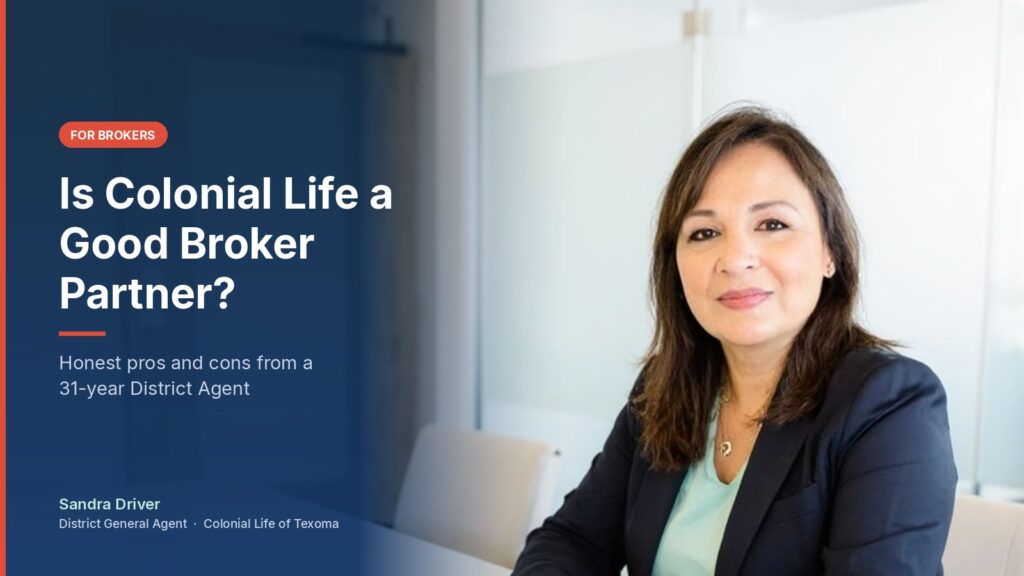
I’ve been with Colonial Life for 31 years. In an industry where agents change carriers every few years, people sometimes ask me why I’ve stayed. The answer is simple: Colonial Life gives its agents the tools to take care of their people and their clients. That’s also the best reason for a broker to partner with us.
The question I get most from brokers looking for a Colonial Life broker partner isn’t about products. It’s “What happens to my client if I bring you in?” Here’s the straight answer, including the parts that don’t flatter us.
The short answer
Colonial Life is a strong partner when your client needs voluntary benefits enrolled well, by a team that will still be there at renewal. It’s a weaker fit when the client wants the cheapest possible voluntary rates and nothing else.
Why I’ve stayed 31 years, and why that matters to you
Carriers come and go, and so do agents. When a broker brings in a voluntary partner, the real risk isn’t the product. It’s that the person who enrolled your client is gone in two years and nobody answers the phone at renewal.
I’ve stayed with Colonial Life for three decades because the company invests in the people doing the work. As a District General Agent, I’m not building a team on my own. Colonial Life gives me what I need to support my agents, and in turn gives my agents what they need to support your clients:
- Training and development that keeps my team current, so the person enrolling your client’s employees knows the products and knows how to explain them.
- Enrollment technology that makes onsite and virtual enrollments run smoothly and gets data where it needs to go, instead of leaving someone to rekey it.
- A national enrollment team I can bring in when a client has employees outside Texas and Oklahoma, so I can partner with a broker no matter where their clients are.
- Service after the sale, so when an employee files a claim or has a question, there’s a system and a team behind it, not just a phone number.
Brokers should care about this for a practical reason. The tools that kept me here are the same tools that make you look good to your client. A well-supported agent runs a better enrollment, employees understand their coverage, participation holds up, and your renewal conversation gets easier.
Longevity isn’t a sales pitch. It’s the thing you can check. I’ve been with this company for 31 years, and I plan to be here when your client renews.
What you get with a Colonial Life broker partner
You stay the broker of record. We work alongside you. Your client relationship, your major medical, and your renewal conversations stay yours.
Enrollment is handled for you, wherever your client’s employees are. This is the biggest difference. My team handles onsite enrollments across Texas and Oklahoma ourselves. For groups with plant floors, rotating shifts, or crews in the field, we can cover multiple shifts so nobody gets skipped. We also enroll bilingually in English and Spanish. If your client has employees in other states, or you’re a broker with clients outside Texas, that isn’t a problem. I bring in Colonial Life’s national enrollment team, so every location gets the same experience and you still have one point of contact: me.
Employees get a one-on-one conversation. When employees enroll through a web portal with no guidance, voluntary participation tends to be low and early cancellations tend to be high. A short conversation with a benefits counselor lets employees understand what an accident or critical illness plan actually pays. That’s what keeps the coverage on the books, and it’s what makes you look good at renewal.
Group and individual options, not one-size-fits-all. Colonial Life offers group products as well as individually owned, portable coverage, so we can design around the client’s budget, workforce, and what employees actually value.
We handle groups of any size. We work with groups from small to large, single-site to multi-state. Turnaround depends on the group, but we’ll tell you up front what timeline is realistic.
Public sector is a strength. If you work with school districts, cities, or counties, we can support those accounts. That includes groups where the major medical is a statewide plan and voluntary benefits are the only place the district can add value.
The honest cons
The lowest rate isn’t always the best fit. Colonial Life offers both group and individual products. Group plans are often the more price-competitive option. Individual plans are owned by the employee and portable, so employees keep them if they leave the job, and that portability can come with a higher premium. We’ll help you choose the right structure for each client. But if your client’s only criterion is the lowest rate on every line, we may not win that comparison.
Enrollment takes employee time. One-on-one enrollment means employees step away from work for a few minutes. Most employers see that as worth it, but some operations can’t spare the time, and you should know that going in.
It doesn’t replace major medical. Our products fill the gaps in major medical coverage. They aren’t a replacement for it. A client looking for an ACA alternative isn’t a Colonial Life conversation.
Not every product fits every group. Some products have participation or eligibility requirements.
Colonial Life vs. Aflac: how brokers should compare
Colonial Life and Aflac are both established worksite carriers, and either can be the right answer. Where they tend to differ is the enrollment model and the support behind the agent, not the product list, since both offer group and individual options. When you compare, ask each carrier four questions:
- How long has the local leader you’ll be working with been with the company, and will they still be there at renewal?
- Who actually conducts the enrollment, are they local, and who covers your client’s out-of-state locations?
- Does enrollment data flow into the client’s benefits administration system, such as Employee Navigator, or does someone have to rekey it?
- What happens after enrollment, when an employee files a claim and calls someone?
In my experience, those answers matter more to your client’s satisfaction than a few cents of rate difference. For the record, my answer to the first one is 31 years.
For a fuller checklist, see 5 questions every broker should ask a voluntary benefits partner.
Is Colonial Life a good broker partner for public-sector accounts?
Usually, yes. Public entities often have limited flexibility on major medical, so voluntary benefits and Section 125 pre-tax options are where a broker can bring something new to the table. These groups also tend to have spread-out workforces (multiple campuses, shifts, and departments), which is where onsite enrollment earns its keep.
Is Colonial Life the right fit for your client?
When Colonial Life is the right call
- ✓Your client has hourly, shift, or field employees who won’t enroll well online
- ✓You want voluntary benefits added without taking on the enrollment workload yourself
- ✓You want a partner whose team will still be there at renewal
- ✓You want the flexibility to choose group or individual coverage based on the client
- ✓Your client is in the public sector, spread across multiple locations, or has employees in more than one state
- ✓Your client cares about participation and retention, not just rate
When it probably isn’t
- ✕The client wants the lowest possible rate and nothing else
- ✕The need is major medical, not supplemental coverage
Frequently asked questions
Why has Sandra Driver stayed with Colonial Life for 31 years?
Because Colonial Life gives its agents the tools to support their teams and their clients, including training, enrollment technology, a national enrollment team, and service after the sale. That support is the same thing that makes it a dependable partner for brokers.
Does Colonial Life offer group products?
Yes. Colonial Life offers group products as well as individually owned, portable coverage, so brokers can choose the structure that fits each client.
Do I lose my client if I partner with Colonial Life?
No. You remain the broker of record. We handle voluntary enrollment and service alongside you.
Can you work with brokers or clients outside Texas and Oklahoma?
Yes. My team handles enrollments across Texas and Oklahoma directly. For brokers with clients in other states, or clients with employees in multiple states, I coordinate with Colonial Life’s national enrollment team, so every location is enrolled consistently while I remain your point of contact.
Do voluntary benefits cost the employer anything?
Voluntary benefits are typically employee-paid through payroll deduction, so there is often no direct premium cost to the employer. For a deeper look, see how much voluntary benefits cost an employer.
How fast can you enroll a group?
It depends on the group’s size and number of locations. Call and we’ll give you a realistic timeline before you commit to anything.
If you’re weighing a voluntary benefits partner for a client, wherever they’re located, I’m happy to talk through whether we’re a fit, including when we’re not. Learn more about working with us as a broker or call me directly at 214-680-1180.

About the author
Sandra Driver
District General Agent, Colonial Life · 31 years with the company
Looking for a partner who’ll still be here at renewal?
Let’s talk through whether Colonial Life fits your client, including when it doesn’t. Or call Sandra directly at 214-680-1180.
Talk to Sandra Driver →